

Address:
92 Xidazhi Street, Nangang District, Harbin City
Zipcode:
150001
Tel:
0451-86413209
Email:
nyxyyzxx@hit.edu.cn
Follow US
on wechat


Address:
92 Xidazhi Street, Nangang District, Harbin City
Zipcode:
150001
Tel:
0451-86413209
Email:
nyxyyzxx@hit.edu.cn
on wechat
 10
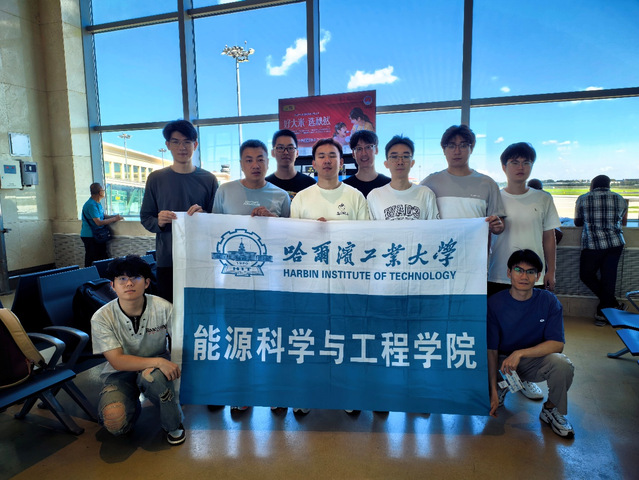
10 To broaden the international academic horizons of graduate students and enhance their research and innovation capabilities, with the support of the Excellent Graduate International Exchange Program of the University's Graduate School, a delegation of 10 doctoral students led by faculty members Yu Jianyang and Yan Han from the School of Energy Science and Engineering paid a short-term academic visit to Singapore from August 27 to 31, 2026. The delegation visited two top-tier universities in Singapore, namely the National University of Singapore (NUS) and Nanyang Technological University (NTU), and carried out a series of in-depth exchange activities focusing on core agendas including study of cutting-edge research achievements, inter-university cooperation and collaboration, and joint doctoral training programs.
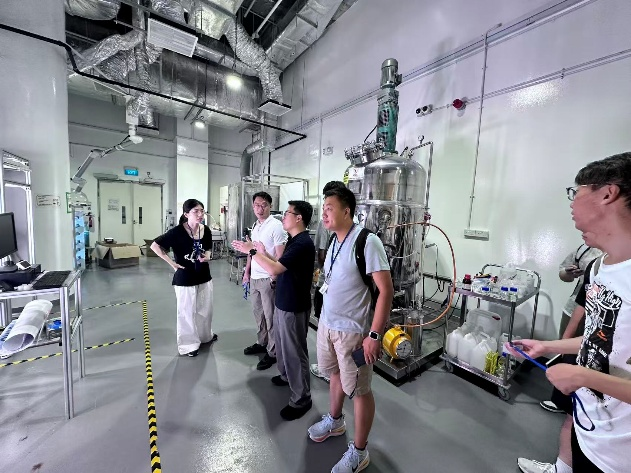
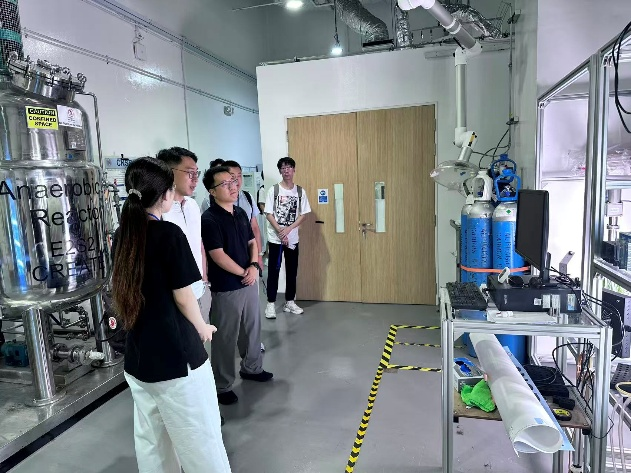
On August 28, the delegation visited the Carbon Negative Synthetic Biology for Biomaterial Production (CNSB) Laboratory at the National University of Singapore for on-site research and academic exchange. Focusing on the frontier of carbon negative synthetic biology, the laboratory conducts systematic research on improving the efficiency of cyanobacterial biological carbon fixation, and explores a green technological pathway to optimize photosynthetic electron transfer and enhance carbon fixation capacity via magnetic regulation. The delegation observed on site presentations of the laboratory’s research achievements, and held in depth discussions with the host university’s researchers on research directions, technical roadmaps and industrial application prospects. Through the exchange, the delegation gained a more comprehensive understanding of how synthetic biology enables cutting edge green and low carbon development, and further broadened their insights into frontier research in energy related interdisciplinary fields.
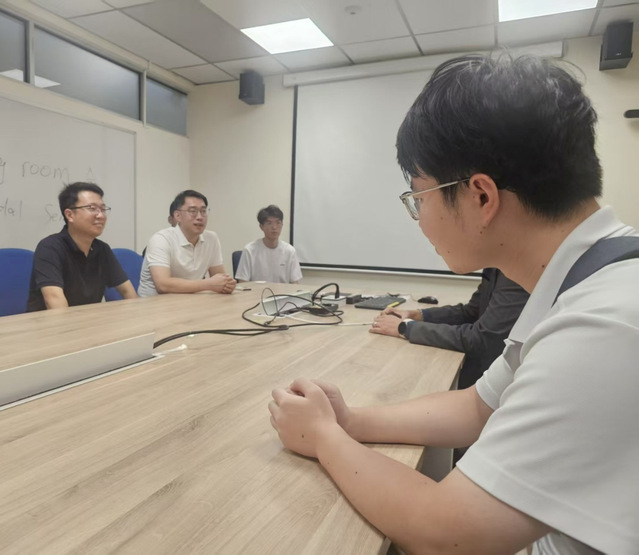
On August 29, the delegation held a special academic discussion with Professor Daniel from Nanyang Technological University (NTU). Professor Daniel has long been committed to cutting-edge research in the fields of aerodynamics and fluid dynamics, with prolific research outputs and a strong reputation in the international academic community. At the opening of the meeting, both sides introduced their respective disciplinary development frameworks, core research priorities and distinctive graduate training systems. They conducted in-depth, specialized academic seminars on mutually focused frontier research directions, brainstorming innovative research ideas and exploring new avenues for cooperation. During the meeting, the accompanying doctoral students from our university, combining their own research progress and practical challenges encountered in their projects, consulted Professor Daniel on a range of issues, including experimental design optimization, breakthroughs in core technical bottlenecks, writing and publication of high-impact papers, and pathways for overseas academic advancement. Drawing on his years of research experience and international academic vision, Professor Daniel provided meticulous answers to each question raised by the students, shared research insights into cutting-edge fundamental research, and offered professional academic guidance and career advice to the participating graduate students, who were greatly inspired and gained enormously from the exchange. Building on this, both sides leveraged their respective disciplinary strengths and development needs to conduct in-depth consultations centered on two key pillars: academic exchange and mutual learning, and high-level talent cultivation. They had a thorough exchange of views on key matters such as inviting Professor Daniel to our university for themed academic lectures and co-developing a joint doctoral training program. Both sides identified areas of convergence for cooperation and mapped out implementation pathways, and initially reached consensus on a number of cooperation initiatives. This laid out a clear direction for the subsequent establishment of a regular inter-university exchange mechanism and the advancement of in-depth cooperation in scientific research and talent development.
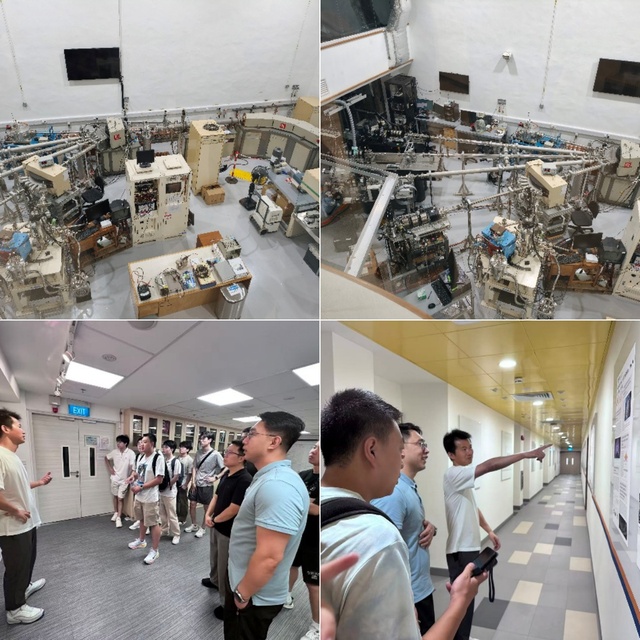
On August 30, the delegation visited the Centre for Ion Beam Applications (CIBA) at the Department of Physics, National University of Singapore for academic exchange. CIBA is a multidisciplinary ion beam research center built upon a 3.5 MV nuclear accelerator. It houses six ion beamlines with dedicated functionalities, capable of producing MeV class high energy proton beams, alpha particle beams and other ion beam sources. Its research and applications cover a wide range of interdisciplinary fields including micro/nano fabrication, biomedicine, material characterization, radiobiology and micro/nano photonics, establishing it as a leading ion beam technology research platform in Southeast Asia. The delegation toured the laboratory’s core large scale accelerator experimental system, and gained a first hand understanding of the overall configuration of the long range acceleration tubes, multi branch beam transport network, supporting precision measurement and control instruments, and multi terminal experimental stations. They focused on inspecting signature experimental facilities such as the proton beam writing system, nuclear microscope and Rutherford Backscattering (RBS) magnetic spectrometer. They also learned in detail about the application scenarios of proton beam writing technology in polymer micro/nano structure fabrication, semiconductor processing, biochips and nanoimprinting, as well as the unique technical strengths of nuclear microscopy in elemental imaging, biomedical research and channeling effect studies of advanced materials. On this basis, both sides held targeted consultations on cooperation priorities including joint doctoral training, collaborative research projects, and shared access to experimental testing platforms. This exchange further broadened the scope of research cooperation between our university and the National University of Singapore in ion beam technology and its interdisciplinary applications in energy, and laid a solid foundation for future interdisciplinary integration and joint innovation.
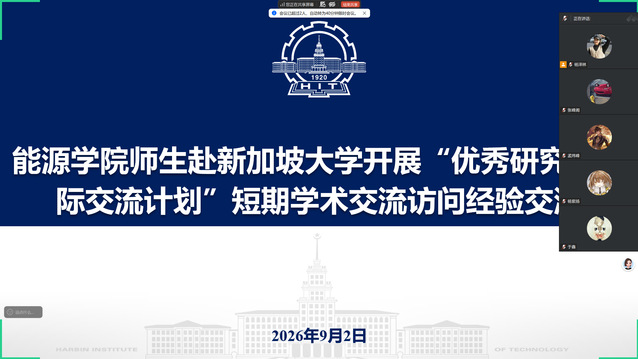
“The academic exchange visit to the National University of Singapore and Nanyang Technological University has given me firsthand exposure to the world-leading academic research system in interdisciplinary energy fields, and enabled me to gain a clear understanding of the research progress and development trends in areas including carbon-negative biological carbon fixation, advanced fluid measurement, and high-energy ion beam technology applications.”
- Qifan Guo
“The cutting-edge interdisciplinary research and innovation ecosystem at the National University of Singapore has consolidated my professional understanding of carbon-negative biological carbon fixation and high-energy ion beam technology. The rigorous and pragmatic engineering research system at Nanyang Technological University has enabled me to grasp the core logic of how fluid experiments empower engineering problem-solving. Through in-depth exchanges and brainstorming with professors and research teams from Singaporean institutions, my innovative thinking has been fully expanded and my international academic perspective has been significantly broadened. This exchange has made me realize that young engineering researchers in the new era should not only solidly delve into professional theories and refine their experimental research capabilities, but also benchmark against international frontiers and serve the needs of industrial development.”
-Wendong Wang
“I was fortunate to join the academic exchange delegation to the National University of Singapore and Nanyang Technological University. Through in-depth conversations with multiple professors, I have drawn profound inspiration. The professors repeatedly stressed that we must dedicate ourselves patiently to basic research. There is no room for eagerness for quick success in scientific research, which must be pursued steadily, step by step. Meanwhile, a critical spirit must be upheld at all times: every dataset deserves careful scrutiny, and every conclusion must be drawn with prudence. It is precisely through such bit-by-bit accumulation that solid scientific literacy is fostered. Furthermore, the professors encouraged us to build confidence, and have the courage to voice our viewpoints and showcase our research achievements on the international academic stage. This exchange has granted me a deeper understanding of scientific research, and also charted a clear direction for my future academic studies.”
- Fengge Zhang


Address:92 Xidazhi Street, Nangang District, Harbin City
Zipcode:150001
Tel: 0451-86413209
Email:nyxyyzxx@hit.edu.cn