

Address:
92 Xidazhi Street, Nangang District, Harbin City
Zipcode:
150001
Tel:
0451-86413209
Email:
nyxyyzxx@hit.edu.cn
Follow US
on wechat


Address:
92 Xidazhi Street, Nangang District, Harbin City
Zipcode:
150001
Tel:
0451-86413209
Email:
nyxyyzxx@hit.edu.cn
on wechat
 10
10 From 9 to 16 September 2026, a faculty delegation from the School of Energy Science and Engineering (SESE) at Harbin Institute of Technology (HIT) visited Kazakhstan for an eight-day program of academic exchange and research cooperation in Almaty and Astana. The delegation comprised seven faculty members: Professor Hong Qi, Deputy Dean of SESE; Professor Jiang Qin; Professor Weixing Zhou; Professor Haochun Zhang; Associate Professor Bo Wang; Associate Professor Lifeng Li; and Associate Research Fellow Zhipeng Ren. Centered on the interdisciplinary research fronts in energy science, the visit combined an international conference, institutional meetings, laboratory visits and the signing of a cooperation agreement, producing concrete outcomes in academic exchange, platform sharing and talent development.
From 10 to 12 September the delegation attended the International Conference on Nuclear and Renewable Energy Resources (NURER2026) in Almaty, where researchers from universities and research institutions in a number of countries delivered talks on nuclear energy, renewable energy and related fields. Faculty members of the HIT delegation presented work on nuclear energy utilization, hydrogen and renewable energy, thermal physics and energy systems, and AI-DFT high-throughput materials design, showcasing the school's recent progress at the energy–physics interface and prompting extensive discussion with fellow participants.
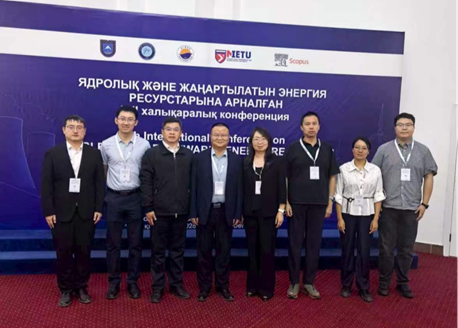
Figure 1. The HIT School of Energy Science and Engineering delegation at NURER2026.
While in Almaty, the delegation visited al-Farabi Kazakh National University (KazNU), where Professor Zhanseit Tuimebayev, Chairman of the Board–Rector of KazNU, received the delegation. He welcomed the visit and praised HIT's achievements in energy science and physics and the quality of its talent development, expressing the hope that the visit would serve as a basis for expanding practical cooperation in the two universities' respective strengths. The two sides exchanged views on sharing academic resources, joint research on key problems, and the joint training of high-level talent, reaching broad consensus. The delegation also toured the university library and other academic resources, gaining first-hand insight into KazNU's research infrastructure and academic environment.
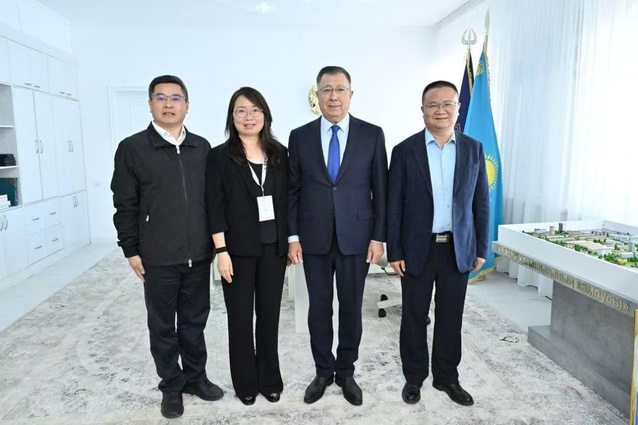
Figure 2. Professor Zhanseit Tuimebayev, Chairman of the Board–Rector of KazNU, receives the delegation.
The delegation then visited the university's Faculty of Physics and Technology, where Dean Professor Nurzada Beissen received the delegation and presented the faculty's cryogenic test platform. According to the Kazakh side, the platform is internationally advanced in cooling-temperature coverage, system stability and experimental precision, and can provide rare experimental conditions and platform support for frontier research at the energy–physics interface. SESE has deep expertise in energy science and engineering thermophysics, and the two sides are highly complementary in sharing cryogenic facilities and in research on the performance of energy materials and systems under extreme conditions. Following the talks, the delegation toured the Thermal Engineering Laboratory, the Cryophysics Laboratory, the Dusty Plasma and Plasma Technology Laboratory, the Wind Energy and Sustainable Technology Laboratory and the university's supercomputing centre, learning about each platform's experimental capabilities, ongoing projects and arrangements for open access. The two sides held focused discussions on sharing the cryogenic platform and on research into energy materials and system performance under extreme conditions, with a view to putting talent development and the building of an international research centre on a sustained, project-based footing.
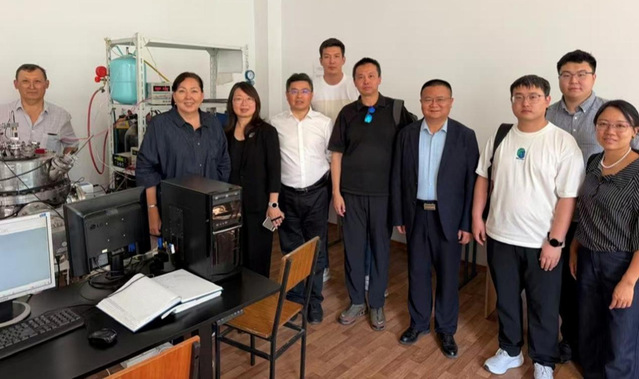
Figure 3. Dean Professor Nurzada Beissen accompanies the delegation on a tour of the Cryophysics Laboratory.
The delegation also visited the Faculty of Mechanics and Mathematics for talks with Professor Aidarkhan Kaltaev, Academician of the National Academy of Sciences of the Republic of Kazakhstan, and Professor Madina Mansurova, Dean of the Faculty. Discussion focused on key mechanics problems in the extraction and transport of low-carbon energy, covering multiphysics modeling of in-situ leaching, solute transport, and pipeline transport and flow-safety assurance. The two sides reached a preliminary understanding on joint numerical simulation and experimental validation, exchanges of academic staff, and joint applications for international research programs. Both agreed that the efficient and safe extraction and transport of mineral resources is an important link in the nuclear energy supply chain, and that strengthening research in mechanics and modeling in this area carries considerable scientific and practical value.
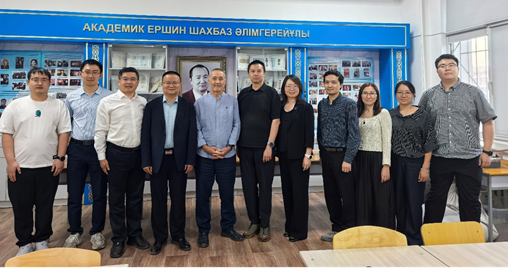
Figure 4. The delegation with Professor Aidarkhan Kaltaev, Academician of the National Academy of Sciences of the Republic of Kazakhstan.
On 14 and 15 September the delegation traveled to Astana to visit the Institute of New Materials and Energy Technologies (INMET) at Nazarbayev University, where they were received by Professor Zhumabay Bakenov, General Director of INMET and Academician of the National Academy of Sciences of the Republic of Kazakhstan. Professor Rehan Sadiq, Provost of Nazarbayev University; Professor Bjorn Birgisson, Vice Provost for Research and Innovation; Dr Aliya Mukanova and Dr Dulat Buketov, Deputy General Directors of INMET; and laboratory directors Professors Nurxat Nuraje, Woojin Lee and Yanwei Wang.
At the welcome ceremony the two sides presented their respective research strengths. Academician Bakenov noted that INMET, established in 2025 on the basis of the Center for Energy and Advanced Materials Science at Nazarbayev University's National Laboratory Astana, is Kazakhstan's leading platform for research on advanced energy materials and energy systems. Its centres and laboratories include the Center of Digital Modelling and AI in Energy, the Center of Nuclear Research, the Laboratory of Energy Storage and Conversion Systems, the Laboratory of Renewable and Hybrid Energy Systems, the Laboratory of Environmental and Sustainable Energy Systems, the Laboratory of Advanced Sensors and Energy Diagnostics, and the Laboratory of Advanced Functional and Conductive Materials, with solid foundations in batteries, nuclear energy, hydrogen and AI computing. He added that Chinese companies including Sinopec, China National Nuclear Corporation (CNNC), PowerChina and GCL Group (Golden Concord Holdings) have already invested in Kazakhstan, creating real demand and application scenarios for industry–academia collaboration, and that Nazarbayev University provides dedicated funding at both university and institute level to support its researchers' international travel. Professor Hong Qi presented SESE's research portfolio and representative results in space energy, energy storage, hydrogen, nuclear materials, and the interface of energy with artificial intelligence.
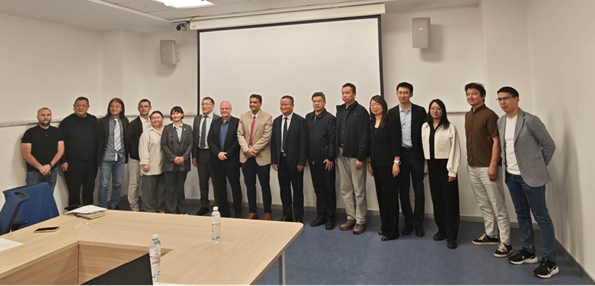
Figure 5. The delegation with Professor Rehan Sadiq, Provost of Nazarbayev University; Professor Bjorn Birgisson, Vice Provost for Research and Innovation; and Academician Zhumabay Bakenov, General Director of INMET.
The delegation then toured INMET's principal research facilities, visiting the Laboratory of Energy Storage and Conversion Systems, the Laboratory of Renewable and Hybrid Energy Systems, the Laboratory of Materials Processing and Applied Physics, and the Center of Digital Modelling and AI in Energy. They examined each laboratory's research directions, platform capabilities, representative outputs and mechanisms for translating results into application, and discussed technical questions with resident researchers on battery and energy-storage materials, renewable energy system integration, materials processing and characterization, and AI-assisted optimisation of energy systems. During the visit the delegation was also invited to the university's Department of Physics, where they toured a two-dimensional materials laboratory and a cryogenics laboratory and learned about work in the preparation and characterization of low-dimensional materials and in low-temperature property measurement and optical sensing.
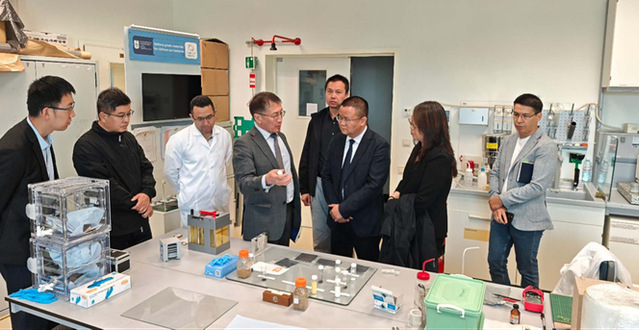
Figure 6. Academician Zhumabay Bakenov accompanies the delegation on a tour of INMET's Laboratory of Energy Storage and Conversion Systems.
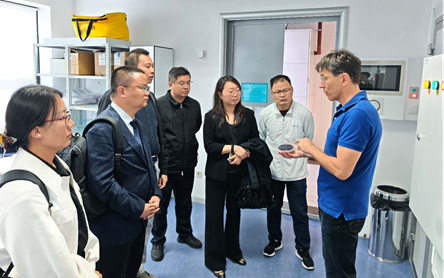
Figure 7. Dr Alexander Tikhonov of the Department of Physics introduces the two-dimensional materials and cryogenics laboratories.
Building on earlier discussions, the two sides held detailed talks on specific areas and modalities of cooperation. They agreed to pursue joint applications for intergovernmental science and technology programs; to strengthen the foundations of cooperation through scholar exchanges, joint student training and co-authored publications; and to invite Kazakh experts to contribute to the development of high-level courses and to continue supporting SESE's International Summer School. They also exchanged views on establishing a joint research centre at INMET and designated contact points and next steps.
The Memorandum of Understanding was signed in the auditorium of Nazarbayev University by Professor Hong Qi, Deputy Dean of SESE, and Academician Zhumabay Bakenov, General Director of INMET. Under the agreement, the two sides will establish the China–Kazakhstan Joint Research Center for Advanced Energy and Power Technology, conducting joint research in four priority areas: green hydrogen and synthetic fuels; nuclear energy and advanced energy systems; energy storage in extreme environments; and thermal management and energy-efficient technologies. They will also hold annual academic meetings on a rotating basis, exchange visiting scholars, and jointly train doctoral students through short-term research visits or a dual-supervisor model. The signing marks a new stage in cooperation between the two universities in energy and new materials.
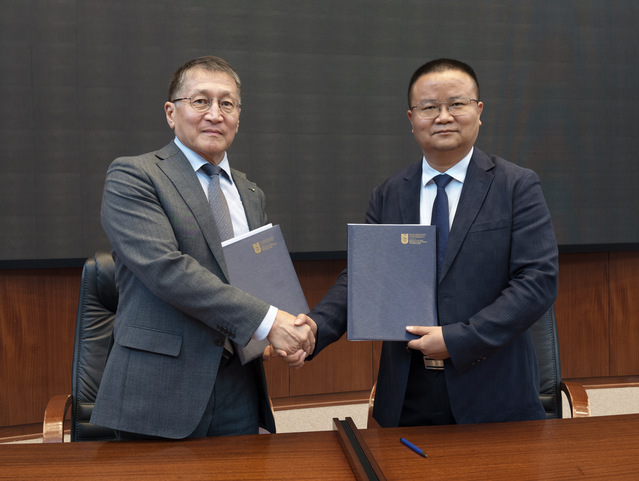
Figure 8. Professor Hong Qi, Deputy Dean of SESE, and Academician Zhumabay Bakenov sign the SESE-INMET cooperation memorandum.
The visit further strengthened HIT's partnerships with al-Farabi Kazakh National University and Nazarbayev University, broadening cooperation in both approach and scope. HIT and the two universities have moved from exchanges and mutual visits to joint platform development, collaborative research, and joint talent cultivation. At the same time, their cooperation has expanded from basic interdisciplinary research in energy and physics to frontier areas such as green hydrogen, advanced nuclear energy, energy storage in extreme environments, thermal management, and high-efficiency energy systems. Going forward, SESE will continue to work through the China-SCO Doctoral Student Training Innovation Center and other platforms to pursue practical cooperation with Kazakh partners in joint talent development, collaborative research and the sharing of academic resources, contributing to China–Kazakhstan exchanges in education, science and technology.


Address:92 Xidazhi Street, Nangang District, Harbin City
Zipcode:150001
Tel: 0451-86413209
Email:nyxyyzxx@hit.edu.cn